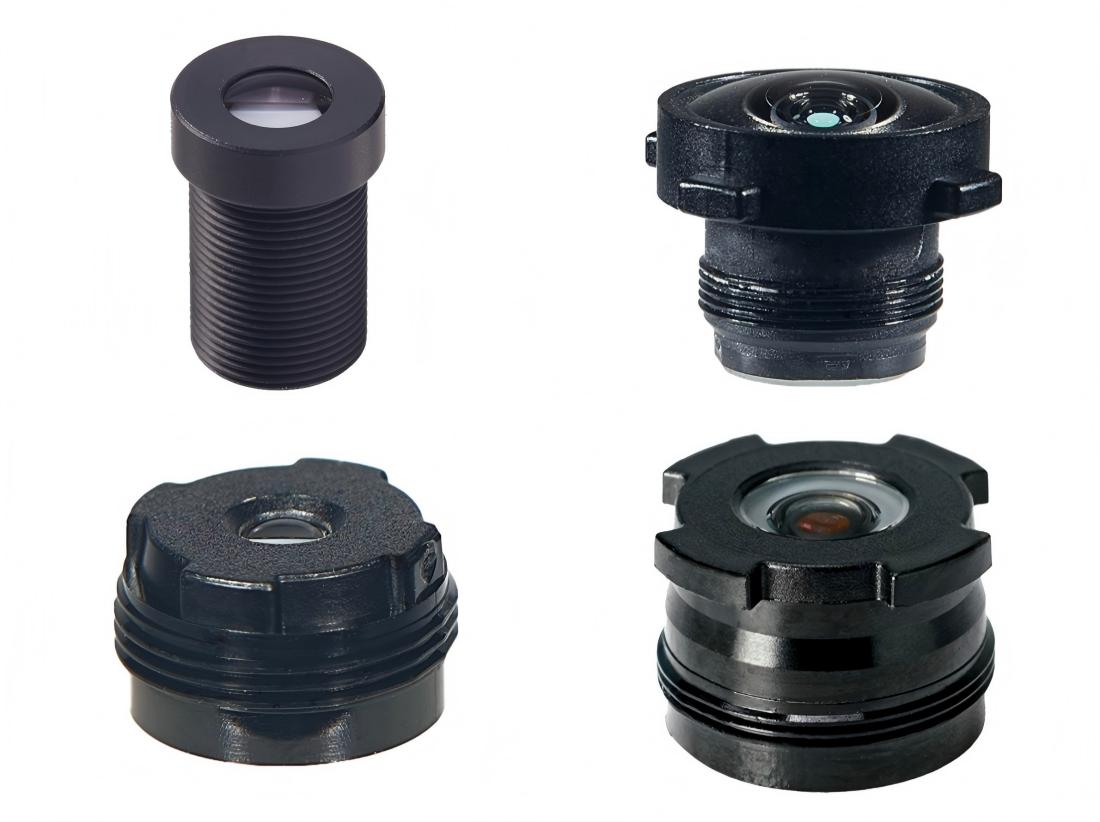
M6 or M6.5 lenses are miniature lenses with an M6 or M6.5 threaded mount. Their main features are compact structure, small size, and light weight. They are typically adapted to small image sensors of 1/4 inch and below and are often used in space-constrained miniature imaging systems.
Key features and advantages of the M6 lens:
1.Small and lightweight, suitable for embedded
M6 lenses typically feature M6×0.35 or M6×0.25 threading; their compact outer diameter and short overall length allow them to be embedded within space-constrained devices, such as endoscopes and pinhole cameras.
Additionally, their lightweight nature makes them an ideal choice for applications with strict weight limitations, such as micro-drones and wearable devices.
2.Easy to install and highly versatile
The M6 lens features a standard threaded mount that screws directly into place, eliminating the need for an additional bracket. It utilizes an industry-standard mount, allowing for the interchangeability of lenses, bases, and mounts across different brands, as well as easy procurement of accessories and flexible replacement options.
3.Low distortion and good image quality
M6 lenses typically feature a low-distortion design and offer superior optical performance; they are well-suited for short-range imaging and meet the demands of high-resolution sensors and wide dynamic range.
For example, when used for endoscopy or close-up photography, the M6 lens exhibits minimal image distortion, meeting the needs of detection and snapshot capture.
4.Compatible with small-format sensors
The M6 lens is designed to be compatible with miniature sensors with small target surfaces, such as those smaller than 1/4 inch. It has high light transmission and field of view matching, high imaging utilization, and no wasted pixels.
5.Good concealment, sealing, and stability
The M6 lens is compact and slim, making it suitable for covert filming. Its threads fit tightly when tightened, and with the sealing ring, it provides basic dust and splash protection. It is not easy to loosen in the vibrating environment, making it suitable for use in assembly lines, mobile devices, etc.
6.High cost performance
The M6 lens features a simple structure and is easy to manufacture, making it suitable for mass production and offering a high cost-performance ratio; it is well-suited for applications such as consumer electronics and civilian security, helping to reduce costs.
Key application areas for M6 lenses:
As indicated above, M6 lenses are compact and easy to integrate, making them well-suited for miniature embedded vision applications. Key areas of application include the following:
1.Industrial automation (miniature machine vision)
M6 lenses are commonly used tools in industrial automation; their ultra-compact size allows for integration into various miniature machine vision devices. They are frequently employed in applications such as industrial inspection and equipment condition monitoring—for instance, inspections on high-speed packaging lines.
2.Scanning and recognition
Some M6 lenses, specifically designed for scanning applications, feature a compact design and a short TTL (Total Track Length); suitable for various scanning devices (such as QR code and barcode scanners), they are commonly used in applications like facial recognition and document/ID scanning.
3.Medical and endoscopy
The miniaturized design of the M6 lens makes it suitable for compact medical devices—such as disposable medical endoscopes and dental endoscopes—commonly used in minimally invasive surgeries and internal examinations.
4.Consumer electronics and wearable devices
M6 lenses are also used in consumer electronics and wearable devices, such as AR/VR equipment, action cameras, laptop webcams, smart door locks, and smartwatches.
5.Security and industrial monitoring
M6 lenses also play a significant role in small-scale security and industrial monitoring. For example, the M6 lens can be found in various security monitoring scenarios, such as dashcams, security monitoring in unmanned stores, and industrial production line monitoring.
Thus, thanks to their miniaturized design and compact form factor, M6 lenses are frequently employed in applications requiring limited space, miniaturization, low cost, and high-volume production, making them a key choice for compact devices and micro-vision systems.